
🪐
Snapchat turns your friendship hierarchy into a living, dynamic cosmos. You are the Sun, and your top 8 contacts orbit you as planets based on your reciprocal communication.
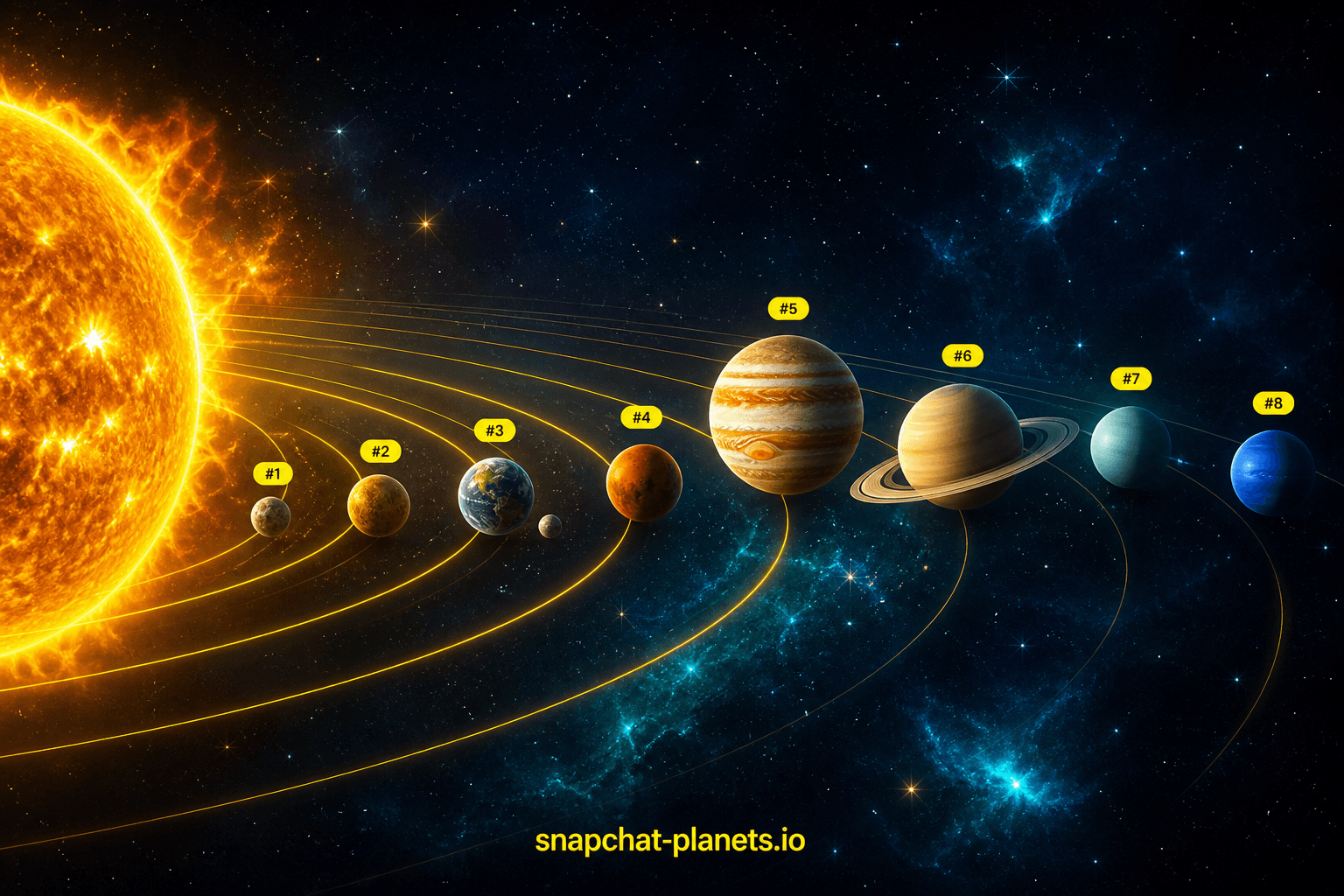
In Snapchat’s Friend Solar System, you are the Sun ☀️ at the center. Your 8 closest best friends orbit you based on reciprocal snap and chat frequency.
You are this person's #1 most contacted friend on Snapchat. You exchange the highest volume of two-way Snaps and active chats.
When viewing your Friendship Profile from someone else’s perspective with Snapchat+, their Bitmoji serves as the blazing Sun ☀️ at the center of their universe. If you are one of their 8 closest friends on the app, you will be placed into an orbital path representing your rank.
The distance of each planet from the Sun directly mirrors their interaction score relative to all other friends:
Mercury, Venus, Earth, and Mars. These planets feature orbiting heart emojis (red, pastel, or purple/blue) indicating active, daily emotional bonds.
Jupiter, Saturn, Uranus, and Neptune. These outer rim planets have stars or plain surfaces with no hearts, indicating casual or less frequent chats.
The Snapchat algorithm recalculates friendship ranks on a rolling basis (updating every 24 to 48 hours). The primary metrics that determine orbit positioning include:
Before you see a planet, Snapchat shows a friendship badge on the profile. Reading the badge correctly avoids a lot of confusion:
Mutual top-8 status: you are in their Solar System and they are in yours. Tap to reveal your planet.
One-sided: you are in their top 8, but they are not in yours (or vice versa depending on whose profile you open). You can still see a planet when Plus + Solar System are on.
You are outside their top 8 right now, Solar System is off, or you do not have Snapchat+. No planet animation available.
| Signal | What it shows | Needs Snapchat+? |
|---|---|---|
| Snapchat Planets | Exact #1–#8 orbit in one friend’s Solar System | Yes |
| Best Friends list | Who you interact with most (broader list; not numbered planets) | No |
| Snap Score | Lifetime snaps sent/received — not friendship rank | No |
| Streaks 🔥 | Daily consistency boost; helps but does not alone decide Mercury | No |
Extended Best Friends (more than 8) can exist on Snapchat, but the Solar System only maps the top eight as planets.
Myth: There is a secret 9th Snapchat planet (Pluto).
Fact: False. Snapchat only assigns eight planets: Mercury through Neptune. No official Pluto / 9th orbit exists.
Myth: Longest streak always equals Mercury.
Fact: False. Streaks help, but two-way snaps, reply speed, and recent activity outweigh streak length alone.
Myth: If I am their Mercury, they must be mine.
Fact: False. Each Solar System is calculated independently.
Myth: Planets are gone / shut down in 2026.
Fact: False. The feature is opt-in and Plus-only — many users think it vanished because the toggle is off.
Myth: You can see planets without Snapchat+.
Fact: False for official badges. Estimators like our calculator approximate ranks from activity inputs only.
Reporting after launch noted that public ranking features can increase anxiety for some younger users — one reason Snapchat made Friend Solar System opt-in and Plus-gated. Parents and teens can leave it off, use Snapchat without Plus, or treat planet ranks as entertainment rather than a friendship scoreboard. If checking ranks affects mood, disable Solar System under Snapchat+ settings.